Hello all! I got some questions from Mrs. Waldrop's fifth graders, and so here are some answers:
Garrett asks, "What's the tallest seaweed you ever saw?"
Sometimes, I dive in Monterey, CA, which is about two hours south of Berkeley. There is a species of kelp there, the giant kelp Macrocystis, which can grow very tall. I have seen some that are more than 40 feet long! But they can grow to more than 60 feet. They are very beautiful and huge!
Payne asks, How big are the crabs there?"
There are a lot of different types of crabs here on Moorea. The ones in the water can be very big (more than 8 inches across) to very, very tiny (a few millimeters). The hermit crabs also have that size range. Last night, we went out on the small island beside Moorea and collected large adult hermit crabs. They were the size of pool cues!
Charlotte asks, "Do crabs have ears?"
No, not like ours. Sound in water travels very quickly, and as a result, it is very hard to tell where a sound is coming from. Crabs and other crustaceans do use sound in water to communicate sometimes, and they can feel the sound vibrations with tiny hairs (almost like your arm hairs) on their shell that move back and forth with the vibrations. It's kind of like how our ears work, but very different at the same time!
Maria asks, "Why do you like to study crabs?"
I like to study crabs because they are very different than people and other animals that I've seen a lot. They don't have a backbone (like us), they sniff really differently too. It is very fun for me to think about what it would be like to be a crab!
Monday, June 7, 2010

Saturday, June 5, 2010
Arrived in Moorea
After a very long day of travel, I'm finally in Moorea at the Gump Station. I started Friday, leaving Oakland International Airport at 9 am to Los Angelos International Airport. From there, I flew 8.5 hours to Papeete, Tahiti. I then spent the night in Papeete so I could catch the ferry to Moorea the next morning. My friend Molly picked me up, and I'm finally here!
Now, it's time to do some science! Pictures to come!
Now, it's time to do some science! Pictures to come!
Wednesday, June 2, 2010
Packing for Moorea: Measuring the Wind
To figure out how hermit crabs use their 'noses' (antennules) to find food, you have to know two things: 1) how hermit crabs actually sniff (we know this already), and 2) what sort of environment they are sniffing in.
Imagine two kinds of environments. Let's say they are in windy, open field and in the woods. What is different about these two environments? The field is windier, scientists would say the wind velocity, or speed, is greater. It is also more 'blustery' in the field, wind is whipping around you in lots of different directions. Scientist call this turbulence, and it describes how mixed up the air is. The woods are less windy because the trees filter all the wind with their leaves and trunks. This makes the wind velocities slower and the wind less turbulent.
Now, imagine you are trying to sniff something out in the field and then in the woods. How could you figure out where the smell was coming from in each environment? Do you think it would be harder to follow a smell out in the open field or in the woods? Would you behave differently following a scent in the field and in the woods?
 Knowing how much turbulence and velocity wind an environment has is important when we are trying to figure out what hermit crabs are doing to find food. So, I have to measure how fast and turbulent the wind is where the hermit crabs live. I can do this with an anemometer, which measures wind velocity. If I take a lot of measurements at different heights above the ground, I can calculate how turbulent the wind is.
Above is a picture of where I collect hermit crabs. You can see two different environments. One is the beach, which is pretty open like a field. The other is in the forest right beside the beach, and the trees filter out the wind. Since hermit crabs live both in the forest and on the beach, I am going to take measurements from both sites and see how they are different from each other. Then I will put a piece of food out for them to find, and videotape how crabs find the food while the wind is blowing.
Here is a video describing the different parts of the anemometer and how it works. What other things do you think I should measure while I'm in Moorea?
And here is a video of us going out into "the field" (Briones Regional Park) to test everything out and make sure it all works before I go to Moorea.
Next stop, Moorea!
Thursday, May 27, 2010
Wednesday, May 26, 2010
Like bugs?! Follow Yonatan in Panama!

My lab-mate Yonatan Munk also has a blog. He studies wingless ants that glide in the rainforest of Panama. Go check it out!
http://ractopus.wordpress.com/
A Letter from Vani at PS 23 in NJ
May 18, 2010
Dear Lindsay,
My name is Vani. I am 9 years old. I like many sports such as soccer. I have 1 brother and 2 sisters. Also I have many friends. They are all nice. Can you tell me a little bit more information about yourself? I will be happy if you do.
Mr Evangelista told me on his blog that you will be studying crabs in French Polynesia so I have a few questions for you about crabs. Where are crabs mostly found? How long is a crabs life span? Do all crabs live in the water and on beaches? Are all crabs meat eaters? These are the questions I have for you.
Good luck finding crabs in the field.
A third grad student,
Vani
Hi, Vani!
I am 26 years old, and I am finishing my fourth year of graduate school. I am from North Carolina. I have one younger sister who lives in Virginia and is very nice. We get along very well. I like to watch football and ride my bike. I also have a dog named Raleigh, and she really loves to play with me.
 The hermit crabs I will be studying in French Polynesia live on the land. They like to stick close to the water, so they you can find them on the beach and in the woods close to the beach. Hermit crabs can live for many years, some species live up to 30 years old!
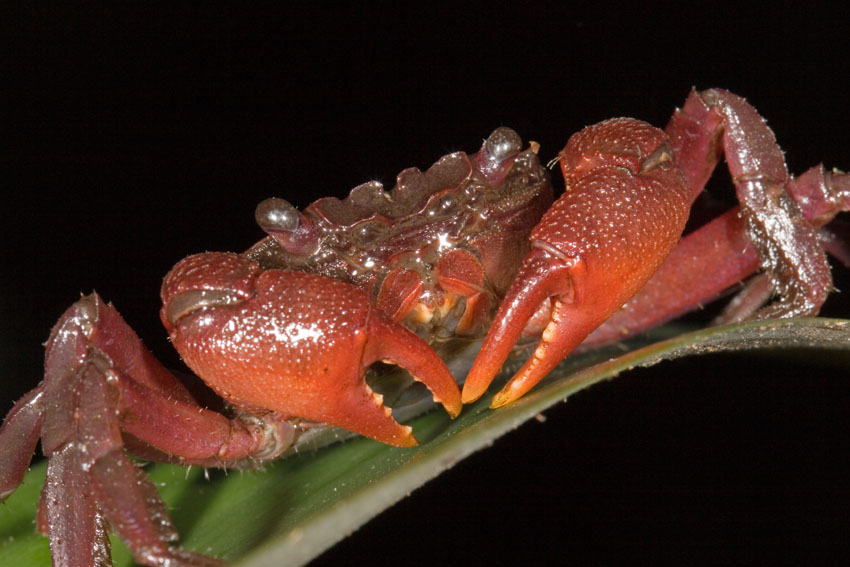
Not all crabs live in the water or on beaches. There are some crabs that live in the jungle, up in plants called bromeliads (see the picture). When it rains, water gets caught in between the leaves of the bromeliads and create little ponds where the crabs live. They can also climb up and down the trees to find food and other crabs.
Not all crabs are meat-eaters, although most of them probably are. Most often crabs are scavengers that eat whatever they can find, stuff like dead animals, snails, and plants and algae. Some crabs only eat algae, but most eat whatever they can find!
I hope you are doing well, and thanks for your letter!
Lindsay
Dear Lindsay,
My name is Vani. I am 9 years old. I like many sports such as soccer. I have 1 brother and 2 sisters. Also I have many friends. They are all nice. Can you tell me a little bit more information about yourself? I will be happy if you do.
Mr Evangelista told me on his blog that you will be studying crabs in French Polynesia so I have a few questions for you about crabs. Where are crabs mostly found? How long is a crabs life span? Do all crabs live in the water and on beaches? Are all crabs meat eaters? These are the questions I have for you.
Good luck finding crabs in the field.
A third grad student,
Vani
Hi, Vani!
I am 26 years old, and I am finishing my fourth year of graduate school. I am from North Carolina. I have one younger sister who lives in Virginia and is very nice. We get along very well. I like to watch football and ride my bike. I also have a dog named Raleigh, and she really loves to play with me.
 The hermit crabs I will be studying in French Polynesia live on the land. They like to stick close to the water, so they you can find them on the beach and in the woods close to the beach. Hermit crabs can live for many years, some species live up to 30 years old!
Not all crabs live in the water or on beaches. There are some crabs that live in the jungle, up in plants called bromeliads (see the picture). When it rains, water gets caught in between the leaves of the bromeliads and create little ponds where the crabs live. They can also climb up and down the trees to find food and other crabs.
Not all crabs are meat-eaters, although most of them probably are. Most often crabs are scavengers that eat whatever they can find, stuff like dead animals, snails, and plants and algae. Some crabs only eat algae, but most eat whatever they can find!
I hope you are doing well, and thanks for your letter!
Lindsay
Tuesday, May 25, 2010
Packing for Moorea: Science Diving Equipment
I put together this short video about all the equipment I have to take with me to Moorea for science diving.
Science diving is a great way to study what lives underwater. What sort of animals do you think I'll see when I dive? What would you study if you could dive for science? How would you study it?
 Molly, my friend, is studying stomatopods, also known as mantis shrimp. These are little crustaceans that are related to crabs and shrimp that smash things with their arms! They can also see much better than we can; they can even see polarized light! We will be collecting them and doing other studies to learn more about how they live. Do you have any questions for Molly about stomatopods?
Subscribe to:
Posts (Atom)
