Here are some new questions and answers for Mrs. Waldrop's class!
Sean asks, Is using the anemometer fun? Is it working right?
The anemometer is pretty fun to work and setup. Taking data is a little boring though, like you saw in the video it is a lot of sitting around and waiting and clicking buttons on the computer. But I am hanging out in a pretty nice place, so it's not too bad at all.
As far as working right, it has been mixed. It is pretty flaky sometimes, the program that runs and takes the data from the anemometer has been not working properly all the time. I sometimes have to close it and open it again so that it saves the way it should, and that is annoying. The thing that has been the worst problem is battery life of the computer, which is around 2.5 hours. I didn't think about this when I was packing and didn't get an extra battery, so I can only use it for that long even though I stay on the motu for usually 4-5 hours at a time.
Maria asks, How do crabs see?
Crabs see a lot like we see. They have eyes like us that use lenses to focus light onto cells that send signals to their brain. But they also see differently. They have compound eyes (like flies) which basically means instead of having one lens per eye (like you), they have a lot of lenses that go all the way around their eyes. This makes it easier for them to see things move, which is really useful if you don't want to get eaten by something! But they are not as good as we are at making out details. Crabs would need some crazy reading glasses!
Emily asks, How many different species of crabs are there?
There are two big groups of crabs that are related to, but a little bit different from, each other. Together, they have about 850 species. Crabs are part of a really big group of animals known as crustaceans. Crustaceans are all things with segments that have exoskeletons and are usually marine (but there are some that live on land). There are about 200,000 species of crustaceans, making it one of the largest and most diverse group of animals alive!
Keri asks, What is the weather like?
French Polynesia is in the southern hemisphere (it is below the equator). It is winter right now here, so it is a little colder and drier than it would be if I were here during November to March. It still rains a lot (like on Sunday!) and is very humid. It is about 80 degrees at night and 85 during the day, so I get to wear shorts and flip-flops everywhere and still be warm. It is not too windy, but last year I was here in July when the trade winds start blowing, and it can be very windy then. I like the weather, except when it rains a lot.
Sarah asks, How many babies do crabs have at once?
Crabs are different than mammals like people or dogs. When they reproduce, they lay eggs, kind of like chickens. Except they lay between 20,000 and 500,000 eggs at a time! Also like chickens, the mom crab will protect her eggs and carries them on her belly until they are ready to hatch. When they are, she shakes her tail and the new tiny babies, called larvae, swim away to grow in the water.
Great questions, y'all! Keep it up! And if you're not in Mrs. Waldrop's class, you can still leave your questions in the comments or email me at lwaldrop[at]berkeley[dot]edu.
Monday, June 14, 2010

Sunday, June 13, 2010
The Mis-Adventures of Field Work
 I haven't posted in a few days because we are very busy here in Moorea trying to get some last things done before I leave on Tuesday.* Don't worry, I will post some in the following days about collecting stomatopods (mantis shrimp), the motus, and an interview with one of the graduate student scientists who is also doing research at the station. But for now, I wanted to tell you about what happens when things don't quite go as planned when you're doing work in the field.
As anyone who has ever had a picnic rained-out can tell you, doing anything outside is sometimes risky. There are a lot of things you can't control outdoors like the weather. This makes trying to do science, which relies on being able to control as many things as possible during an experiment, sometimes very difficult. You can plan and prepare for things to not work (having extra things in case one breaks, having alternate plans and more time in case something happens), but some things you just aren't expecting and wouldn't even think about happen! Friday and Sunday were two of "those days."
 On Friday, we went to the motus (small islands) off the coast of Moorea so I could gather more wind measurements and collect some small hermit crabs. When I got there, I set up the computer and the anemometer, just like always, and started to collect some data. What I wasn't expecting was that three dogs came by with a woman who wasn't watching them very closely. These dogs were very friendly but huge and not well-trained. I got jumped on and scratched by one very excited dog, and since I was in a bathing suit, it was pretty painful. I have some deep scratch marks and bruises along the inside of my left leg now, but luckily they are healing nicely. The dogs also were playing in the water and the sand. Now, sand and saltwater don't tend to make computers and anemometers very happy, so I had to work very hard to cover them up with my clothes so they wouldn't get sprayed with sand and also to try to lure the dogs away from that area. And at the same time, take the data that I needed! It went very slowly because the dogs liked me a lot (even though I was telling them to shoo!) and they decided to hang out for a couple hours. By the time they left, my computer battery was dead and I had only taken one set of measurements when I really needed three. Sometimes, as I learned that day, things happen that you can't predict, and you have to just make-do the best you can!
Sunday was quite the adventure as well. Molly and I were diving to collect more stomatopods, and our morning dive went fine. In the afternoon, it started to pour rain (as it does in the tropics), which wasn't a big deal because we were going to be underwater anyway. We loaded our gear into the boat and drove out to the dive site. We did our dive (it was still pouring rain) and then started to go back to the station. Well, our boat had other plans. About half way home, the motor stopped working. We were stranded in the water, and it was getting dark! Luckily, we were shallow enough that we could anchor the boat and swim back to shore. We walked back to the station in our wetsuits (and got some pretty strange looks from people driving by), then got someone to tow our boat back to the dock with another boat. We were very wet, pretty miserable, and extremely tired, although nothing a hot shower, dinner, and a good night's sleep can't fix.
Some people say that science is boring. Those people are not field biologists. Science in the field can be dramatic, scary, and dangerous. It is also thrilling and exciting when you figure something out for the first time or collect some animal that no one has ever seen before or see an animal in its natural environment do something that defies easy explanation. I love science because it is unpredictable and exciting, although sometimes I wish that it would rain a little less.
* I should say "might" leave on Tuesday because the fire-fighters in French Polynesia are on strike, the airport is closed, and all flights to and from Tahiti have been canceled. I might have to stay a few days longer than planned.
Tuesday, June 8, 2010
Moorean Science Fair


On Monday I was lucky enough to be able to attend the GK-12 Moorean Science Fair, put on by the fifth graders of Moorea. It was pretty fantastic, and I took a lot of pictures and talked to a lot of interesting kids. We couldn't talk too much because I don't speak French, and they didn't speak English! But we did talk a little bit through Molly or Rayo, a Tahitian lady who was helping Molly out with the fair.
The kids on Moorea learn a lot about the plants and animals that live on and around their island. They learn about invasive species that threaten the natural plants and animals, too. They learn about the ecosystems in and around the island that the plants and animals live in.

Here are some posters that they drew. You can see that they have a lot of tasty fruits, and they are learning about where they live and the names of the plants in both French and Tahitian.

They also learned about the marine animals that live there. On Saturday, Molly, Sho, and I did a dive to collect some animals for them to see. We collected some sea cucumbers, a pin-cushion star (see photo), a black pearl oyster (see photo), and a slipper lobster (see photo). They call the slipper lobster, "cigar del mare" which means "sea cigar!"

They even did some science experiments. In this one, they tested whether or not motor oil would affect the way seeds sprouted. They found that not as many seeds sprouted if they had been sprayed with water mixed with motor oil. This is why you shouldn't pour things like that down the drain!

I had a lot of fun helping out at the fair. And even though I don't speak French, it sure looked like they were having fun too!

Monday, June 7, 2010
First visit to the motu

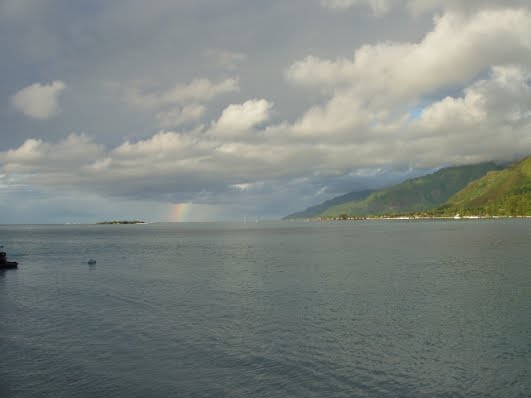
On Sunday evening, we drove out to the other side of Opunohu Bay and kayaked over to the small islands that are on the northwest corner of Moorea. It is a very short kayak, maybe a quarter of a mile, across a 40-50 ft deep channel. When we arrived, there was a great view of the north face of Moorea with a rainbow.
 There were three other researchers with me. Molly, my friend who studies mantis shrimp, spent a little time digging up them and their burrows in the sand flats that had about 2 ft of water over them. We saw a black tip reef shark cruising very close to her, looking for flatfish, and we had to call out "shark!" But Molly wasn't worried, because sharks are actually pretty cool and it didn't want to stick around after it realized we were in the water anyway.
 Sho is a post-doc (already has her Ph.D.) working on crab larvae. She and I went out to the end of the motu to set up a light-trap to catch larvae, which are attracted to light like moths. We also saw a pretty cool sunset on the motu.
Pete is an etymologist (someone who studies insects) working with the Moorea BioCode project. He was collecting moths to study their diversity on the island; he also used a light trap to attract them.
 I waited until dark and then used a headlamp to walk around and collect large hermit crabs. I saw probably two dozen really big ones, ranging in size from a plum to a baseball! The hermit crabs come out at night to scavenge for food and to return to the sea to fill up their shells with water, which prevents them from drying out during the day. I saw two species that are closely related: the Strawberry hermit and the ruggie hermit.
I still haven't taken pictures of them, but I'll update the blog when I do!
Questions from Mrs. Waldrop's class
Hello all! I got some questions from Mrs. Waldrop's fifth graders, and so here are some answers:
Garrett asks, "What's the tallest seaweed you ever saw?"
Sometimes, I dive in Monterey, CA, which is about two hours south of Berkeley. There is a species of kelp there, the giant kelp Macrocystis, which can grow very tall. I have seen some that are more than 40 feet long! But they can grow to more than 60 feet. They are very beautiful and huge!
Payne asks, How big are the crabs there?"
There are a lot of different types of crabs here on Moorea. The ones in the water can be very big (more than 8 inches across) to very, very tiny (a few millimeters). The hermit crabs also have that size range. Last night, we went out on the small island beside Moorea and collected large adult hermit crabs. They were the size of pool cues!
Charlotte asks, "Do crabs have ears?"
No, not like ours. Sound in water travels very quickly, and as a result, it is very hard to tell where a sound is coming from. Crabs and other crustaceans do use sound in water to communicate sometimes, and they can feel the sound vibrations with tiny hairs (almost like your arm hairs) on their shell that move back and forth with the vibrations. It's kind of like how our ears work, but very different at the same time!
Maria asks, "Why do you like to study crabs?"
I like to study crabs because they are very different than people and other animals that I've seen a lot. They don't have a backbone (like us), they sniff really differently too. It is very fun for me to think about what it would be like to be a crab!
Garrett asks, "What's the tallest seaweed you ever saw?"
Sometimes, I dive in Monterey, CA, which is about two hours south of Berkeley. There is a species of kelp there, the giant kelp Macrocystis, which can grow very tall. I have seen some that are more than 40 feet long! But they can grow to more than 60 feet. They are very beautiful and huge!
Payne asks, How big are the crabs there?"
There are a lot of different types of crabs here on Moorea. The ones in the water can be very big (more than 8 inches across) to very, very tiny (a few millimeters). The hermit crabs also have that size range. Last night, we went out on the small island beside Moorea and collected large adult hermit crabs. They were the size of pool cues!
Charlotte asks, "Do crabs have ears?"
No, not like ours. Sound in water travels very quickly, and as a result, it is very hard to tell where a sound is coming from. Crabs and other crustaceans do use sound in water to communicate sometimes, and they can feel the sound vibrations with tiny hairs (almost like your arm hairs) on their shell that move back and forth with the vibrations. It's kind of like how our ears work, but very different at the same time!
Maria asks, "Why do you like to study crabs?"
I like to study crabs because they are very different than people and other animals that I've seen a lot. They don't have a backbone (like us), they sniff really differently too. It is very fun for me to think about what it would be like to be a crab!
Saturday, June 5, 2010
Arrived in Moorea
After a very long day of travel, I'm finally in Moorea at the Gump Station. I started Friday, leaving Oakland International Airport at 9 am to Los Angelos International Airport. From there, I flew 8.5 hours to Papeete, Tahiti. I then spent the night in Papeete so I could catch the ferry to Moorea the next morning. My friend Molly picked me up, and I'm finally here!
Now, it's time to do some science! Pictures to come!
Now, it's time to do some science! Pictures to come!
Wednesday, June 2, 2010
Packing for Moorea: Measuring the Wind
To figure out how hermit crabs use their 'noses' (antennules) to find food, you have to know two things: 1) how hermit crabs actually sniff (we know this already), and 2) what sort of environment they are sniffing in.
Imagine two kinds of environments. Let's say they are in windy, open field and in the woods. What is different about these two environments? The field is windier, scientists would say the wind velocity, or speed, is greater. It is also more 'blustery' in the field, wind is whipping around you in lots of different directions. Scientist call this turbulence, and it describes how mixed up the air is. The woods are less windy because the trees filter all the wind with their leaves and trunks. This makes the wind velocities slower and the wind less turbulent.
Now, imagine you are trying to sniff something out in the field and then in the woods. How could you figure out where the smell was coming from in each environment? Do you think it would be harder to follow a smell out in the open field or in the woods? Would you behave differently following a scent in the field and in the woods?
 Knowing how much turbulence and velocity wind an environment has is important when we are trying to figure out what hermit crabs are doing to find food. So, I have to measure how fast and turbulent the wind is where the hermit crabs live. I can do this with an anemometer, which measures wind velocity. If I take a lot of measurements at different heights above the ground, I can calculate how turbulent the wind is.
Above is a picture of where I collect hermit crabs. You can see two different environments. One is the beach, which is pretty open like a field. The other is in the forest right beside the beach, and the trees filter out the wind. Since hermit crabs live both in the forest and on the beach, I am going to take measurements from both sites and see how they are different from each other. Then I will put a piece of food out for them to find, and videotape how crabs find the food while the wind is blowing.
Here is a video describing the different parts of the anemometer and how it works. What other things do you think I should measure while I'm in Moorea?
And here is a video of us going out into "the field" (Briones Regional Park) to test everything out and make sure it all works before I go to Moorea.
Next stop, Moorea!
Imagine two kinds of environments. Let's say they are in windy, open field and in the woods. What is different about these two environments? The field is windier, scientists would say the wind velocity, or speed, is greater. It is also more 'blustery' in the field, wind is whipping around you in lots of different directions. Scientist call this turbulence, and it describes how mixed up the air is. The woods are less windy because the trees filter all the wind with their leaves and trunks. This makes the wind velocities slower and the wind less turbulent.
Now, imagine you are trying to sniff something out in the field and then in the woods. How could you figure out where the smell was coming from in each environment? Do you think it would be harder to follow a smell out in the open field or in the woods? Would you behave differently following a scent in the field and in the woods?
 Knowing how much turbulence and velocity wind an environment has is important when we are trying to figure out what hermit crabs are doing to find food. So, I have to measure how fast and turbulent the wind is where the hermit crabs live. I can do this with an anemometer, which measures wind velocity. If I take a lot of measurements at different heights above the ground, I can calculate how turbulent the wind is.
Above is a picture of where I collect hermit crabs. You can see two different environments. One is the beach, which is pretty open like a field. The other is in the forest right beside the beach, and the trees filter out the wind. Since hermit crabs live both in the forest and on the beach, I am going to take measurements from both sites and see how they are different from each other. Then I will put a piece of food out for them to find, and videotape how crabs find the food while the wind is blowing.
Here is a video describing the different parts of the anemometer and how it works. What other things do you think I should measure while I'm in Moorea?
And here is a video of us going out into "the field" (Briones Regional Park) to test everything out and make sure it all works before I go to Moorea.
Next stop, Moorea!
Subscribe to:
Posts (Atom)
